
Pilgrim’s Regress
What’s a new Camino veteran to do?

OK, so I announced my intention to return home after the Camino with a pilgrim mindset. That sounds nice.
But what does it mean?
As someone who’s traveled extensively, had “mountain top” mission experiences, and even lived internationally, I’m familiar with the basic outlines of return culture shock. That’s one reason I was keen to create some buffer time with friends and family in Europe before coming home.
And it’s also a reason I was so grateful to be doing the Camino at the beginning of a planned sabbatical year. I can only imagine the extra challenges for those pilgrims who are jolted immediately back into a typical full-time work setting…
THUD!
By contrast, my landing was a little softer. More like…
Fwomp.
Nevertheless, it was still disorienting to wake up each day to read emails, doomscroll on my phone, stare at a desk full of bills, or the myriad other household and life tasks awaiting me. No simple, clear, embodied mission for each day (Walk to “X”), nurtured by a larger community and a whole lot of yellow arrows.
If I really wanted to truly integrate the Camino’s lessons into my life back home, I needed some sort of compass to compensate.
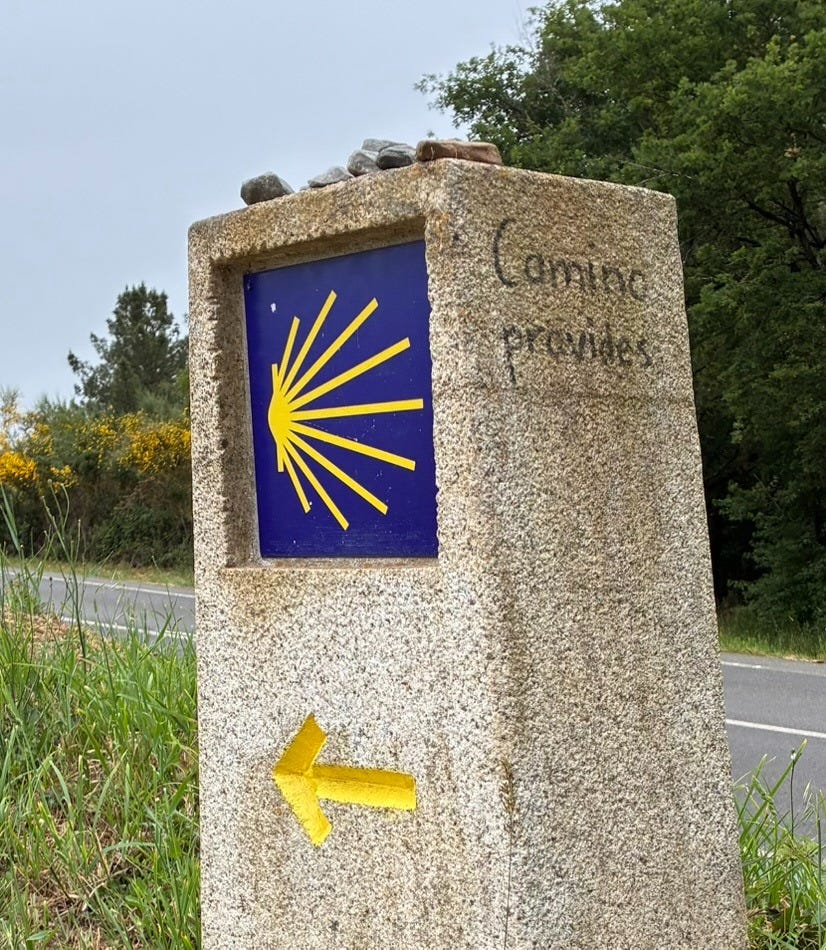
As is often the case in this blog, I found inspiration from another author’s book title. This time it was the semi-autobiographical allegory by C.S. Lewis, The Pilgrim’s Regress. Although I’m an unabashed Lewis enthusiast, I have to admit I never could finish this book. (Is this a theme?!) I just got lost amid the litany of obscure literary and philosophical allusions, and the prose itself just kind of left me cold.
I later learned that, not only was it Lewis’ first book, but he was not writing The Pilgrim’s Regress for people like me. He actually had only a few specialized scholars at Oxford in mind. As the popularity of his later books attest, and even Lewis himself would admit, his writing eventually got broader–and better.
What’s relevant now, though, is the title. It’s a play on John Bunyan’s classic Puritan allegory, Pilgrim’s Progress, which portrays life as a series of challenges to be faced en route to a life of character and eventual welcome into “the celestial city” (heaven).
In the preface to The Pilgrim’s Regress, Lewis has this to say about it: “It is a kind of Bunyanesque allegory, but with this difference, that it is not concerned with the stages of the Christian life, but with the stages of my own ‘reconversion’… the way in which I had to unlearn nearly everything I had been taught before I could come to Christianity.”
Ah, now that’s something I could freshly relate to. Not necessarily the specifics of my initial religious conversion (that’s a different, longer story). But the notion of unlearning various old ways of being in order to embrace a new identity.
Unlearning Old Ways
You see, it’s relatively straightforward to embrace a pilgrim mindset on the Camino de Santiago. There is, of course, the long, arduous quest before you. Then there are the numerous embodied practices that enable the journey–endurance walking, daily washing, foot care, cerveza time, and of course “second breakfast.”
And then there’s the rich community of hosts and fellow pilgrims of all ages, nations, and motivations with whom you give and receive hospitality. Throw in some rituals–like call-and-response “Buen Caminos” exchanged along the trail and nightly pilgrim blessings at local churches–and even those who’ve never heard the word pilgrim before start to “try on” the identity for size, and eventually to embrace it.
But back in the U.S., not so much.
Here we don’t have one shared goal, but thousands.
We live online, not in our bodies.
We move fast and break things.
We ground our identities in our work.
Community takes much longer to form.
And we relentlessly acquire, acquire, acquire.
It’s striking how freshly apparent all that becomes after being on pilgrimage for five weeks. Where slowness is a feature, not a bug. Where identity is rooted more in our purpose than our CVs. Where strangers become friends over lunch. And where simplicity is the name of the game.
Don’t get me wrong. The U.S. is my home. “Land that I love” and ALL that! And as my immigrant friends and patients over the years gladly attest–it’s an incredible place to get ahead.
But now it just feels like an increasingly hard place to be human.
One of the most jarring realities upon my return was the sheer number of options that confronted me each day. Which channel or streaming service to watch? Which place to eat? Which clothes to wear? Do I want my hash browns scattered, smothered, covered, chunked, diced, peppered, or capped?!!!
To be fair, the onslaught of choices is a widespread modern problem (OK, perhaps not the Waffle House conundrum!). Especially in urban areas. Few places will–or should–closely resemble life on the road as a backpacker in rural Spain.
But the challenge before me remained: How to fashion some semblance of the Camino “Way” over the next year in the midst of my own American hometown?
Walk the Walk
One simple “baby step” was self-evident: Just. Keep. Walking.
So, I found myself looking for ways–any way–to incorporate walking into my life more and more. Sometimes that meant deliberate excursions into our many wonderful local and state parks in Tennessee. Sometimes that meant walking rather than driving to nearby establishments, even if it cost me some time. And sometimes that simply meant taking aimless strolls through our neighborhood. (Some bemused neighbors have begun to wonder…)
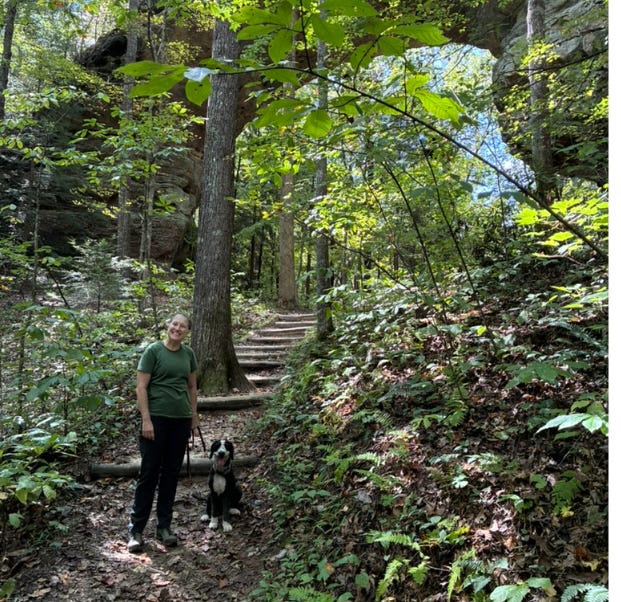
There’s much more to say on this topic in a future post, but the simple practice of walking has increasingly become a part of my “new normal” back home.
Talk the Talk
Another step was less obvious, but equally helpful: Just. Start. Talking.
People were curious about the experience. And I realized that was a gift. Oftentimes, pilgrims return home, and no one really wants to hear them wax on and on about all they’ve learned and experienced. And I’ve understandably encountered some of that, too.
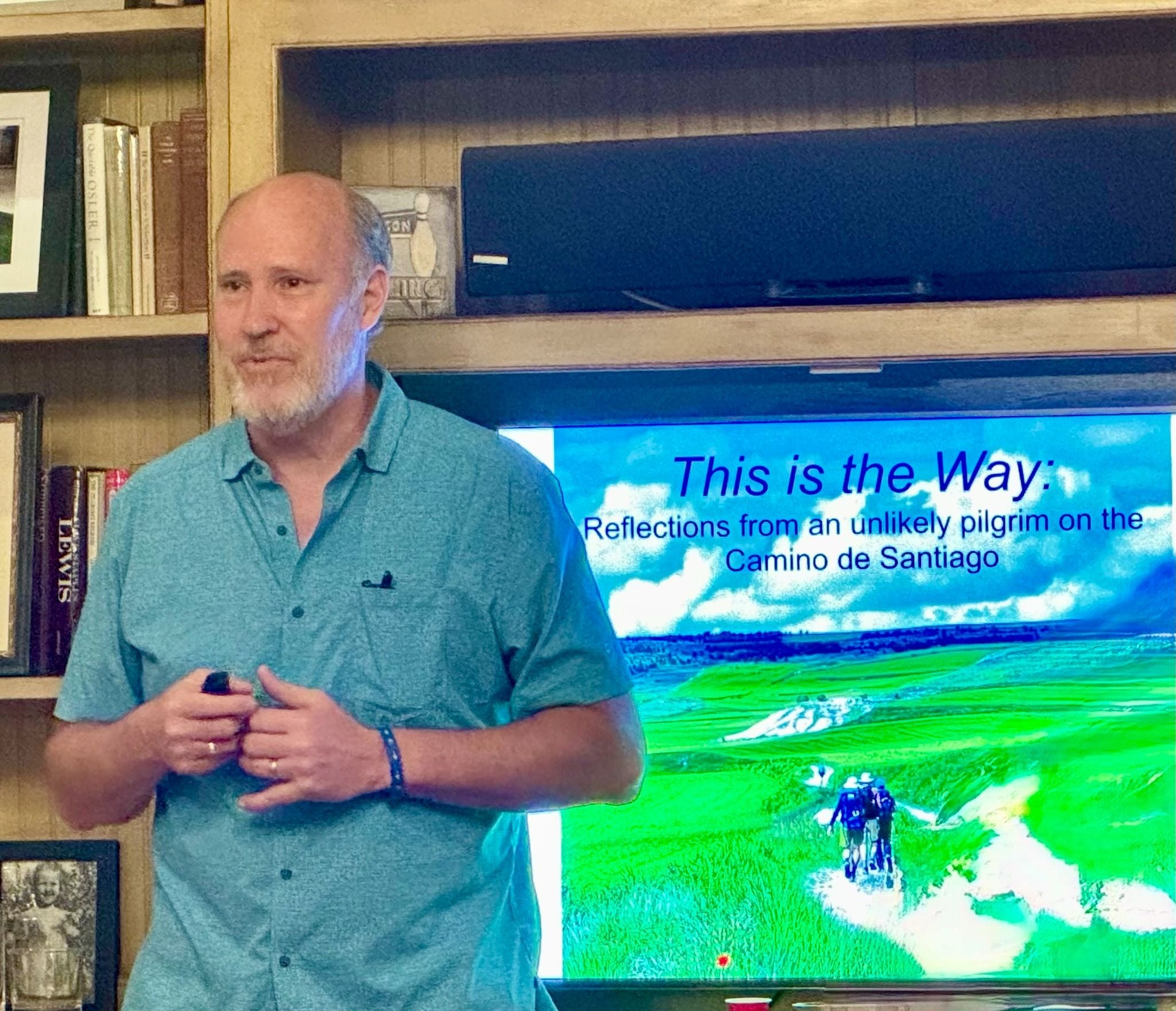
But when friends genuinely ask about it, I’ve committed to seizing the day and talk! Not just in one-on-one conversations, though those have been many, but in organized presentations at my home, church, and various outside organizations. Just as teaching on any topic can help you truly begin to master it, the opportunity to prepare reflections about the Camino helped me to organize my thoughts–and to keep some essential Camino themes fresh in mind.
Seeking Beauty
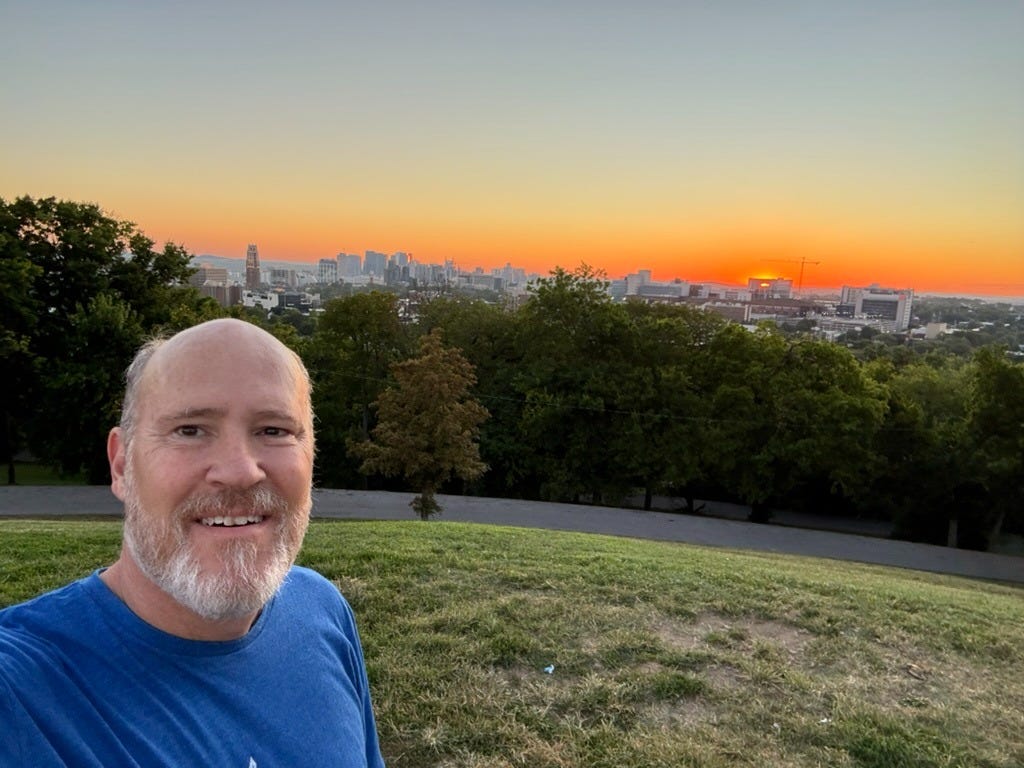
One of those critical Camino themes was the role of beauty. Whether in God’s cathedral of nature or mens’ cathedrals of stone, beauty on the Camino was a constant tonic, a balm for weary hearts and legs. Beauty repeatedly de-centered me, triggering critical but too scarce emotions like awe and wonder. And those emotions, in turn, fostered an openness to others.
I was bound and bent to be on the lookout for beauty in my own backyard. And, lo and behold, I’ve kept finding it!
Let it Go
Living out of a 32 liter backpack for 5 weeks is a great primer in simplicity. There’s frequent clothes washing, but there’s not much time spent wondering what to wear.
My Camino-inspired commitment to simplicity, however, was immediately challenged upon my return. In addition to the sheer force of American consumer culture, and my own—if I’m honest—deep (de)formation by it, there was the very practical challenge of sorting through loads of stuff left by my parents.
The timing of my Camino had been triggered by the death of my father. And, as the second parent to die in our family, that meant there were a whole lot of possessions to sort through. That’s charged business. And the good news is that my brothers and I had done a lot of this work both logistically and emotionally over the previous few years as my parents downsized.
But as the co-owner with my father of our vacation home in Monteagle, Tennessee, I had the unique challenge of de-cluttering a whole separate home by myself. This was a place we have loved for years. But it’s also a place where years’ worth of furniture and curios that my mother couldn’t find a place for in Nashville came to roost.
LOTS of them!
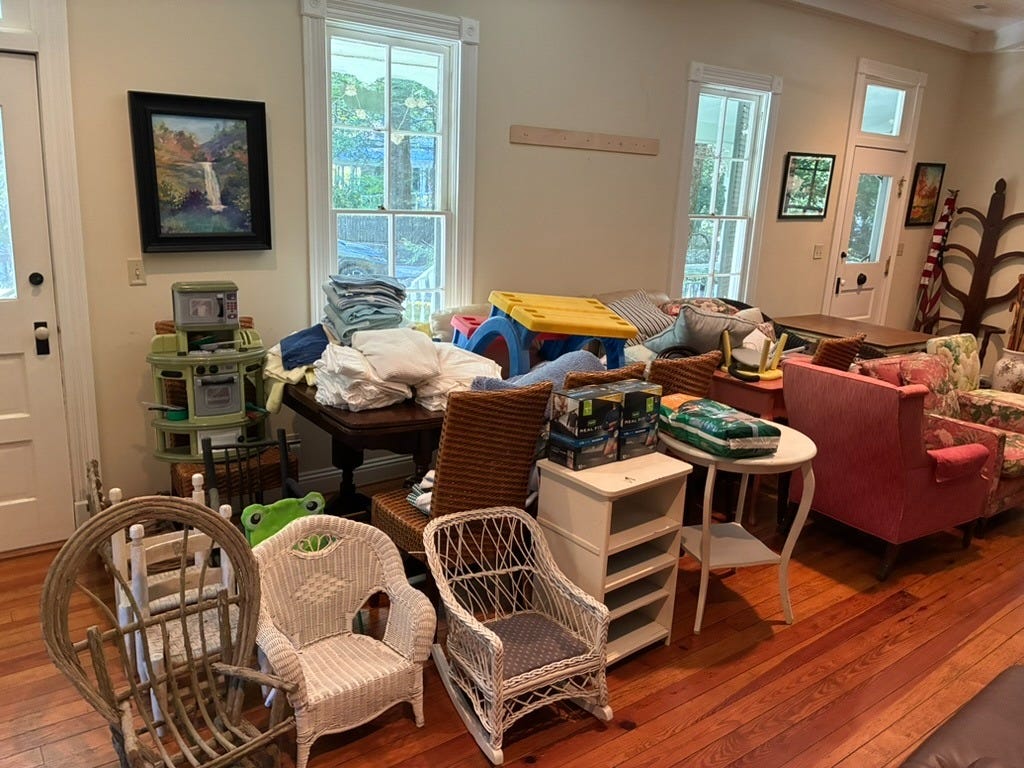
And so, as an exercise of simplicity for myself (and of love to my wife, who was still too busy to deal with it!), I set about the task of thinning out and reclaiming that second home as our own. I’m so grateful for the help of our friends, Wendy and Mark, who volunteered to help me with the purge. Amazingly, they actually enjoy this sort of thing!
Embracing Play
Last but not least, I would be remiss not to mention how important fun was on the Camino!
Yes, there was silence and solemn contemplation, tears and fears. But there was also… Serendipity. Uno. Spontaneous karaoke. Self-deprecating silliness. Whimsy. The Camino had time and space for all of it. And I knew that I needed to keep space for it back home as well.
One simple step was just to lower my threshold for throwing a party. They didn’t need to be big or fancy. They could range from a firepit fellowship to a welcome home party to a whiskey tasting or a Camino re-hash. And they’ve been great fun!
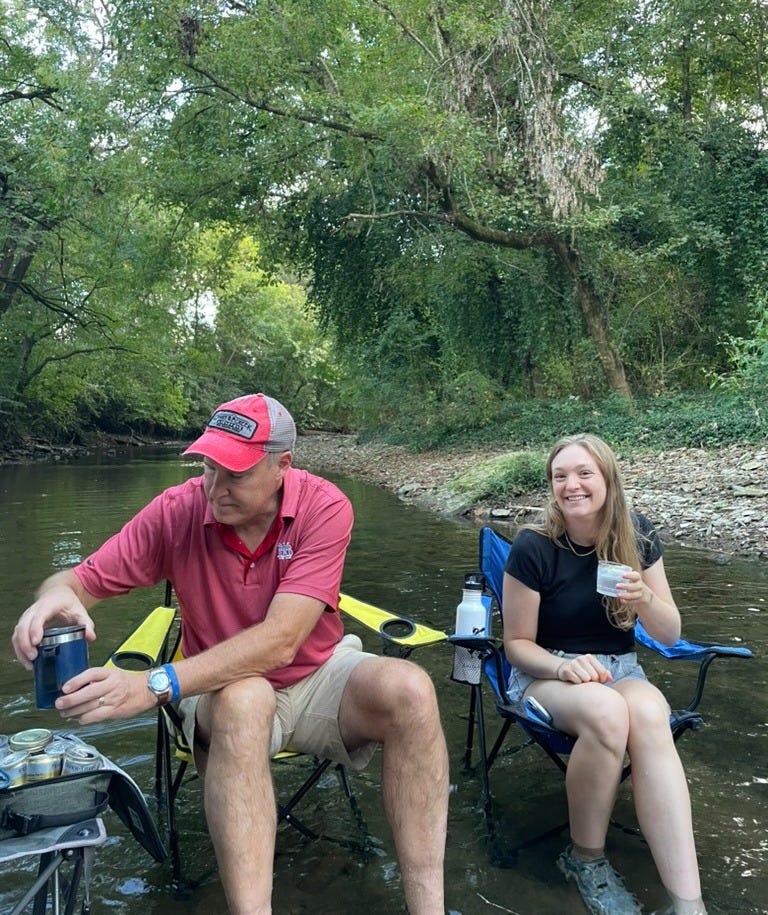
I’ve also learned to throw small parties for two—or four, if you count our dogs. For instance, after a tip from a friend, Heather and I have found ourselves venturing out periodically for “creek cocktails” at a local stream not far from our house. The hidden oasis, just off a local greenway, feels surprisingly isolated for being so close to midtown Nashville. And the forest-like shade and constant flow of water keep you cool on muggy summer evenings. And it’s cheap!
We bring folding chairs to set up smack dab in the middle of the creek, break out some beverages and snacks, and toss a frisbee with our dogs to their hearts’ content. And occasionally we invite a few other two-legged guests along as well.
Baby Steps
Walking. Talking. Seeking Beauty. Simplifying. Playing.
It’s hard to unlearn old ways of being. But these were some great initial “baby steps” as I returned to my old stomping grounds.
What still felt lacking, however, was the sense of an all-encompassing, rigorous quest. Something that I might not be able to handle, at least without a whole lot of grace. Something that might challenge me deeply.
Then I thought: Who knows? Perhaps the Camino will provide that, too…
I would love to hear more about your experience of talking about the Camino as it something all of us want to do non stop but we don't have formal channels for it - just constantly telling our friends and families. Were faith groups more receptive to hearing stories or were they looking for some profound revelations?!
One of my priorities was to write more (this substack is part of that) and to adopt mindfulness to keep my journey. I was obsessed with learning about Pilgrimage and had so many ideas about how it would be a big part of my life - but instead I gifted it to become my mother's new life!